🛡️ Safety – theory test questions and answers – Page 8
400 official Israeli theory questions on Safety, with the correct answers. Read them all or practise them for free online.
Completely free. No sign-up, no payment.
- Why is it required to keep a distance from our front, rear and sides?✓ To ensure response time and space to avoid threats from other vehicles.
- Who is responsible for keeping a safety distance from the front, rear and sides while riding a motorcycle amongst other vehicle?✓ The motorcyclist only.
- What is the most important measure a motorcyclist can take while driving besides or nearby other vehicles?✓ Pay strict attention to the movements of other vehicles in good time.
- How is a motorcyclist required to overtake another vehicle?✓ From the left side of the overtaken vehicle, while keeping a proper side distance from it.
- When are you (a motorcycle rider) required to return to your driving lane at the end of overtaking?✓ After first glancing in the mirrors and then making another check by looking briefly backwards over your right shoulder.
- The main factors affecting a motor cycle riders ability to identify obstacles on the road are:✓ The motorcycle’s position on the road and in traffic.
- The main factors affecting a motorcyclist’s ability to try and evade objects that fall from a vehicle in front are:✓ Keeping distance and maintaining an effective field of vision at all times.
- What risk do riders of two-wheelers face while passing between two rows of cars that stand before an intersection?✓ They might hit pedestrians who are not using a regulated pedestrian crossing.
- What risk do riders of two-wheelers face while passing between two rows of moving cars before an intersection?✓ Being hit by a car that suddenly swerves from its lane to the passage in which the motorcycle is proceeding.
- What basic equipment and clothing are required for a safe ride?✓ Full helmet, rigid-cloth pants, high shoes, gloves and a basic riding jacket.
- What considerations are taken into account in choosing a motorcycle helmet?✓ The helmet should be standard, provide full protection (also to the chin) and fit the size and shape of the rider’s head.
- Continuous braking on a winding descent can cause:✓ Over heating and weaker braking than normal.
- How would you choose appropriate shoes for riding a motorcycle?✓ You should choose high shoes made from a friction-resistant fiber material.
- Where on the motorcycle is it recommended to place luggage, so that its impact on the motorcycle’s stability is minimal?✓ Close to the center of the motorcycle and as low as possible, so that the luggage doesn’t stick out from the front or rear.
- What is the danger of riding a motorcycle on a wet roadway?✓ Motorcycle skidding and roll-over, the greater the speed is.
- What is the risk of riding a motorcycle in the dark?✓ The difficulty to assess the nature of the road and to detect obstacles in time.
- What is the connection between the leaning angle and the turning of a motorcycle and the motorcycle’s headlight?✓ The more the motorcycle is leaned or turned, the more its light beam is diverted from the desired direction of driving.
- How does the helmet’s visor affect driving in the dark?✓ A scratched or dirty visor breaks the light rays and significantly lessens the quality of vision
- How can you improve your vision when driving a motorcycle in the rain?✓ By using an unscratched helmet visor and wipe it with vapor and moisture repellents.
- What is the proper seating position of a passenger on a motorcycle?✓ Sitting astride a regulated seat, with his feet placed on the feet supports and holding a handle or the rider..
- What are the important emphases as regards to motorcycle riding with a passenger?✓ The passenger should be guided how to properly get on and off a motorcycle, and how to position himself correctly on it.
- What’s the correct manner for braking whilst riding a motorcycle?✓ The front and rear brakes should be operated together in order to slow-down and stop.
- How would we pass a road obstacle while riding a motorcycle?✓ Slow down before the obstacle.
- What is the most important thing a motorcyclist should check before entering an intersection?✓ That the intersection is clear of traffic that might endanger him.
- What is the correct way to adjust the motorcycle’s mirrors?✓ In a standing position, when the motorcycle and its handlebar are aligned in one line.
- How would you keep your vehicle balanced when approaching a curve in the roadway?✓ You should slow down before entering the curve, and accelerate when coming out of it.
- What shoukd a driver check after driving through deep water on the road?✓ If the brakes work efficiently.
- The ability to control a vehicle:✓ Increases when driving at a suitable speed for the varying road conditions.
- What should you do to reduce the effect of dazzle (blinding) during the dark?✓ Keep the windshield clean.
- Why are you required to be more careful while driving after dark?✓ Because visibility (seeing and being seen) is limited.
- A panoramic mirror:✓ Causes the objects that reflect in it to look smaller and farther.
- The risk of skidding on a wet road is greater:✓ The faster you drive.
- Which driver related ability is impaired during fog?✓ Vision
- Accidents that are a result of driver fatigue might occur:✓ When the driver’s level of alertness decreases.
- How would you avoid colliding with a vehicle that drives in the same direction you?✓ Keep a sufficient distance from the vehicle in the front. and at the side
- Driving at night with the high beam can cause:✓ The dazzling ( blinding )of other drivers.
- Whilst driving on a rough road, you should:✓ Slow down and increase your alertness.
- What might be the cause of loss of control of a vehicle?✓ Driving too fast, lack of vigilance and being unfamiliar with the vehicle.
- The auxiliary (parking/hand) brake is used by the driver:✓ To secure his vehicle from any movement.
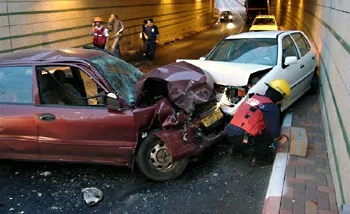 A road accident is an incident✓ Unintentional, resulting in injury, including the driver, or property damage, or both.
- What should a motorcycle rider do when he steps on the foot brake, but the foot brake doesn’t function?✓ He should try to brake by using the hand brake(front brake) and by shifting into low gear.
- How would you drive a motorcycle on a rough non-urban road?✓ Drive slower because there is a risk of losing control.
- When approaching a junction with no traffic signs and you wish to turn right, whilst another vehicle approaches the junction from your opposite direction, you should:✓ Continue driving carefully.
- When approaching a vehicle that unloads children, you should:✓ Slow down and drive cautiously at a low speed.
- When a rear camera is installed in a vehicle:✓ It displays the dead spots behind the vehicle.
- How is a driver required to adjust the vehicle’s head rest?✓ The upper edge of the head-rest should be aligned with the upper tip of the driver’s head.
- A cement mixer is:✓ a commercial truck.
- A freeway is designated for:✓ Only Vehicles which are capable and permitted to drive at a speed of 55 k.p.h .
- Is there a connection between the driver’s judgment and the use of drugs and alcohol?✓ They both impair the driver’s judgment.
- When is there a danger of vehicle skidding?✓ During the first rain or when there is mud or oil on the road.