🛡️ Safety – theory test questions and answers
400 official Israeli theory questions on Safety, with the correct answers. Read them all or practise them for free online.
Completely free. No sign-up, no payment.
- When driving in reverse:✓ You are permitted to use another person to guide you.
- Under which circumstances should you slow down your driving?✓ When your vehicle or any passerby and property are at risk.
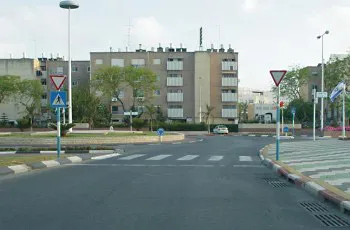 When you arrive with your vehicle to the place that is illustrated in the following picture, you must:✓ Slow down.
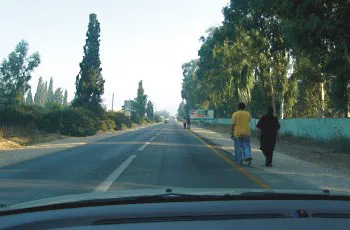 According to the following picture you are obliged to:✓ Slow down.
- When is it permitted to perform an emergency stop?✓ In order to prevent a road accident that cannot be prevented in any other way.
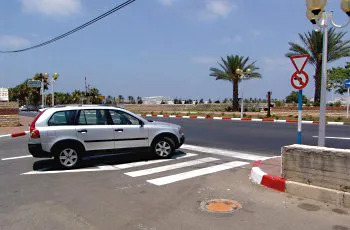 How would you conduct yourself when approaching the intersection that is depicted in the following picture?✓ Slow down and even stop if necessary in order to give right-of-way.
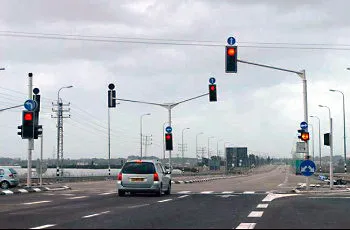 How would you conduct yourself under the situation that is depicted in the following picture?✓ Stop before the junction and do not enter into it.
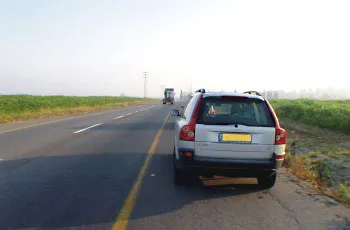 What should you do when you are about to start driving after stopping or parking at the side of the roadway?✓ You should signal appropriately and ensure that you can merge with the traffic without endangering other road users.
- Driving down a long steep hill on a n Inter-urban road✓ Sow down, change down to a lower gear according to the gradient
- Which type of vehicle is allowed to stop or be left standing on the hard shoulder of an inter-urban road which is marked as a main road?✓ A vehicle engaged in public works and an I.D.F vehicle - for the purpose of fulfilling their duties.
- When driving in reverse:✓ You are permitted to use another person to guide you.
- Where is it permitted to park LPG (Liquid Petroleum Gas) fuelled vehicles?✓ In LPG-Vehicle permitted parking lots, according to the directions of the Ministry of Environmental Protection.
- Does a-can of beer have a lesser effect on a driver compared to a whisky shot?✓ No. They both have a more or less equal effect on the driver’s ability to drive safely.
- “Beer is not considered as an alcoholic drink”:✓ Incorrect. The influence of beer is similar to that of any other alcoholic drink.
- “You are allowed to drive under the influence of alcohol, as long as you do not mix different types of drinks”: Correct or incorrect?✓ Incorrect. The determining factor is the level of alcohol in the blood in relation to the legally allowed level.
- “Alcohol slows down the driver’s ability to respond”: Correct or incorrect?✓ Correct.
- “Drinking alcohol disrupts the driver’s judgment and as a result he takes more risks”: Correct or incorrect?✓ Correct.
- “Drinking alcohol disrupts the coordination between limbs”: Correct or incorrect?✓ Correct.
- “Drinking a large quantity of alcohol disrupts the driver’s peripheral vision and field of vision”: Correct or incorrect?✓ Correct.
- ”When you drink alcohol, it will take you more time to recover from dazzling(blinding)”. Correct or incorrect?✓ Correct.
- “Drinking alcohol has an adverse effect on eyesight”: Correct or incorrect?✓ Correct.
- “Drinking alcohol impairs the driver’s ability to estimate distances and speeds”: Correct or incorrect?✓ Correct.
- Does drinking alcohol cause sleepiness?✓ Yes.
- “Drinking alcohol has a negative effect on the driver’s ability to react”: Correct or incorrect?✓ Correct. Alcohol is a suppressive drug.
- What is a reasonable speed on a freeway(Motorway)?✓ A speed that takes into account traffic conditions, and that doesn’t exceed the permitted speed limit on that road.
- Driving on a wet road creates:✓ A danger of skidding and turning-over, as speed increases
- A vehicle driver must slow down when he:✓ Drives down a steep or long descent.
- Braking distance is the distance the vehicle passes?✓ From the moment of applying the brakes until the vehicle reaches a complete stop.
- Choose the only correct sentence:✓ The stopping distance is always greater than the braking distance.
- The danger of skidding on a wet road is greater:✓ The more worn-out are the tires.
- When parking a vehicle, is it necessary to operate the parking brake (handbrake)?✓ Always.
- You step on the brake pedal and feel that the service brake (foot brake) is not working. What will you do?✓ Try to brake using the hand break.
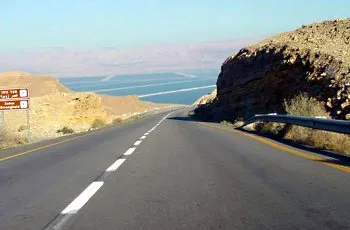 What are the advantages in looking far ahead?✓ It allows you to plan your drive according to the road’s condition and to avoid being surprised by other road users.
- How can we avoid danger when we start driving and when we merge with traffic?✓ By giving an appropriate signal with the winker, looking in all directions and waiting until no one is obstructed.before driving.
- What is the first thing you need to do after entering the vehicle and before starting to drive?✓ Make sure the hand-brake is applied and adjust the driver’s seat.
- What is the order of actions the driver needs to take before slowing down?✓ Glance at the mirrors, ease off the accelerator pedal and use the brakes or gears.
- Which factors affect the driver’s decision to shift to higher or lower gear?✓ The vehicle’s speed, considering traffic condition, road condition and visibility.
- How do you secure a parked automatic-transmission vehicle (except for a vehicle with a robotic gearbox)?✓ Shift into parking gear (P) and secure the parking brake.
- Before starting to drive, what action needs to be taken by the driver before moving the automatic transmission selector?✓ Apply the foot-brake, to prevent the vehicle from moving.
- In order to start driving, what is the action the driver has to take before releasing the hand-brake in a vehicle with automatic transmission?✓ Apply the foot brake pedal, to prevent the vehicle from moving.
- How would you conduct yourself in a vehicle with automatic transmission, when driving down a continuous steep road?✓ Apply the brake pedal intermittently to slow the vehicle down and shift into a lower gear, depending on the slope.
- How would you start the engine of an automatic transmission vehicle?✓ Make sure the hand brake is applied, and the gear selector is in (P) or (N).
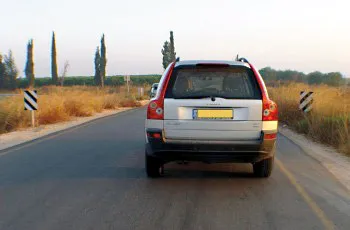 Why is it important to drive on the right side of the road?✓ In order to keep a distance from incoming traffic from the opposite direction, and reducing the risk of “head on” collision.
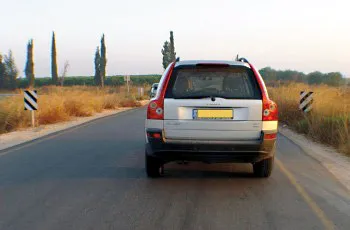 What is the advantage of driving on the right side of the road?✓ It helps to escape quickly to the “hard shoulders” in case of danger.
- What is the advantage of driving on the right side of the road?✓ You are not preventing other vehicles from overtaking
- How does driving on the right side of the road affect drivers' field of vision?✓ Keeping to the right improves the field of vision of the drivers in the vehicles behind you.
- What is the advantage of driving on the right side of the road?✓ You create a safety distance between yourself and oncoming vehicle traffic.
- What risks are caused when you deviate abruptly between lanes?✓ Risk of hitting a vehicle that you didn’t see before deviating.
- What is required in order to change lanes without causing any disturbance or risk?✓ The driver should give a timely signal from a sufficient distance, perform a peripheral check in all directions, and glance at the mirrors, before starting to change lanes.
- What is the correct way for changing lanes?✓ First perform a check and glance at the mirrors, then check the lane you want to pass to, verify that you can pass to it and then deviate moderately (diagonally) to the other lane.