
🚦 Rules and regulations – theory test questions and answers – Page 14
901 official Israeli theory questions on Rules and regulations, with the correct answers. Read them all or practise them for free online.
Completely free. No sign-up, no payment.
- What is the all up weight of a vehicle that is required to have a braking system check at least once every half a year?✓ 16,000 kg or more.
- Explain the term “axle” in a vehicle:✓ Shaft or system of drive shafts running the width of the vehicle, on which the wheels are installed.
- Explain the term “gross axle weight”:✓ The overall weight of all the wheels installed on one axle against the road.
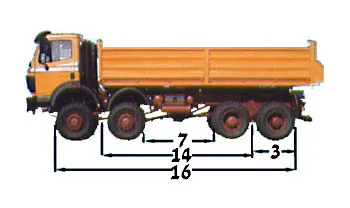 Which number marks the “wheelbase” of this vehicle?✓ 14
- What is a “commercial vehicle”?✓ A motor vehicle used or designed to transport goods.
- According to the driving work hours’ regulation, can freight-handling be accounted as driving?✓ Yes. Freight handling, arranging, loading and unloading is lawfully accounted as driving hours.
- What is the responsibility of the controller of the vehicle as regards to the work and rest hours of the vehicle’s driver?✓ The controller of the vehicle must not permit the vehicle’s driver to exceed statutory work hours.
- What is the correct way of driving downhill?✓ By driving in one of the gears.
- When is it obligatory to operate the speed retarder while driving downhill?✓ When a “dangerous descent” sign is posted.
- Is it permitted to stop a vehicle on a freeway?✓ No, except for stopping on the “hard shoulder” when the vehicle malfunctions and it is impossible to continue driving,
- What is a “path”?✓ part of a road that is not a roadway and designated for specific users.
- While driving during “lighting up time” in a vehicle with an overall width of 220 cm, is it obligatory to turn-on the “Extremity“ side lights?✓ Yes.
- Is it permitted to drive a vehicle when one of the wheels of its trailer or semi-trailer is not in contact with the road (due to the way in which it was connected or loaded to the vehicle)?✓ No.
- Is it permitted to tow more than one trailer?✓ Yes, but only with a permit of the Licensing Authority.
- You are driving a private vehicle with an all up weight of 1520kilos. What is the maximum trailer weight you are permitted to tow?✓ 750 kg.
- Can the details specified in the bill of lading serve as proof of the freight’s weight?✓ Yes.
- When a policeman instructs a driver to bring his vehicle for weighing – who is required to pay the weighing expenses if an irregular weight is found?✓ The driver.
- Is a policeman permitted to instruct the driver of a freight carrying vehicle to bring the vehicle to a weighing station?✓ Yes, a policeman is permitted to instruct the driver of a freight carrying vehicle to bring the vehicle for weighing at the closest possible place.
- Is a policeman permitted to stop a vehicle that carries freight in an unlawful manner?✓ Yes, a policeman is permitted to stop the vehicle until the freight is unloaded or until the matter is lawfully settled.
- Is it obligatory to mark oversize freight on a vehicle?✓ Yes, it is always obligatory to mark oversize freight.
- Is it obligatory to mark oversize freight on a moving vehicle at all times?✓ Yes, it is always obligatory to mark oversize freight.
- How should oversize freight be marked from the vehicle’s front or rear sides?✓ The freight shall be marked from its front with white light reflecting triangle, and from its rear with a white triangle with red light-reflecting margins.
- Is a company that was not approved to operate as a haulage contractor, allowed to transport hazardous materials?✓ No.
- In which vehicle is it permitted to transport loose ash and bulk cement?✓ Only in a vehicle specially designed for this work
- How should cargo be transported in a vehicle that has no separate driver’s compartment?✓ The vehicle must have a partition that separates and protects the passengers from being hit by the cargo.
- What is an “interchangeable crate?✓ crate, box or any other means for carrying goods, designed to be loaded on or off the vehicle with a permanent crane
- A “permanent crane” is:✓ A fixture that is permanently installed in the vehicle and designed to lift or lower interchangeable crates..
- What is a “freight container”?✓ Shipment tank or box used for transporting goods, equipped with a twist anchor bolt and of a maximum width of 250 cm.
- On which vehicles is it permitted to carry a freight container longer than 610 cm?✓ On a semi-trailer only and according to the provisions of the vehicle’s registration document.
- Is it permitted to transport a freight container that sticks out from the vehicle’s rear?✓ No, the freight container should never stick out from the vehicle’s rear.
- Is it permitted to transport a freight container on a vehicle that is not equipped with twist locks?✓ No.
- What is “perimeter lighting” according to traffic regulations?✓ A yellow lighting system arranged around an oversize freight. The distance between lamps should not exceed 100 cm.
- How would we mark a vehicle that escorts a vehicle carrying oversize freight?✓ With “caution oversize freight” signs on the escorting vehicle’s front and on the back of the freight-carrying vehicle, and by mounting a flashing yellow light above the driver’s compartment.
- What is the required driving distance between the escorting vehicle and the vehicle carrying oversize freight?✓ A distance in which the two vehicles can maintain eye contact at all times.
- What should be the road positioning of a vehicle that escorts a vehicle carrying oversize freight?✓ On a two-way roadway he should drive before the freight carrying vehicle, and on a one-way roadway he should drive behind him.
- Does every tractor have to install a reverse buzzer?✓ Yes.
- What is the maximum permitted freight height during bulk transportation?✓ The freight or any part of it should not be higher than the sides of the vehicle or ladders that were legally installed.
- What is the maximum permitted height (together with freight) of a vehicle with an all up weight of 15,000 kg or less?✓ 4 meters.
- According to the law, is there any significance to the manner in which the freight is arranged on the vehicle?✓ Yes,it should be ensured that the freight is arranged and anchored to the vehicle so it doesn’t fall off.
- How would we mark a commercial vehicle with an all up weight of more than 3,500 kg that transports at least 11 passengers?✓ By placing a “passengers” sign in the front and back.
- What is the maximum number of passengers permitted on a commercial vehicle with an all up weight exceeding 3,500 kg, which has no standard chassis for passenger transportation?✓ Six passengers, besides the passengers that sit next to the driver.
- At what minimal distance from a residential building or a public structure is it permitted to park a vehicle transporting hazardous materials?✓ 400 meters.
- On a roadway with curbstones, how should we park uphill a commercial vehicle with an all up weight of more than 5,000kg?✓ Turn the front wheels towards the center of the road, shift to forward drive gear and place safety shoes behind the rear wheels.
- During the night, where is it prohibited to park a commercial vehicle with an all up weight of more than 10,000 kg?✓ Wherever the local traffic sign authority placed a sign prohibiting this type of vehicle from parking or waiting.
- What is the duty of a driver of a vehicle with an all up weight of more than 3,500 kg, while standing his vehicle on a inter-urban road during lighting-up time?✓ He must always place a warning triangle, and also place a portable light or turn on the four winkers (distress lights).
- It is prohibited to stand or park a vehicle on a road, if the vehicle’s width is more than:✓ 2.50 meters.
- Which type of vehicle is it prohibited to stand or be left standing on a road?✓ A trailer that was disconnected from a Semi-trailer or a trailer that was disconnected from a towing vehicle.
- Which of the following commercial vehicles is prohibited from driving faster than 80 k.p.h on an inter-urban road?✓ Commercial vehicles with an all up weight of 12,000 kg or more.
- A traffic sign forbidding vehicles to drive faster than 70 k.p.h is placed on an urban road. Which of the following vehicles is forbidden to drive according to the sign’s speed indication?✓ Commercial vehicles or work vehicles with an all up weight of 12,000 kg. Their speed limit is 50 k.p.h.
- When is a driver required to drive on the “hard shoulder” - where the “shoulder” is asphalt-paved and free of traffic - in order to allow another vehicle to overtake him?✓ When a driver of a motor vehicle is forced to drive very slowly due to the freight he’s carrying or to the steepness of the road, and he delays the traffic behind him.