
🛡️ Safety – theory test questions and answers – Page 3
400 official Israeli theory questions on Safety, with the correct answers. Read them all or practise them for free online.
Completely free. No sign-up, no payment.
- What reason justifies an unexpected pull from the roadway into the “hard shoulder”?✓ Sudden appearance of an undesirable element in the driving lane.
- What is the risk in braking while being forced to pull onto the “hard shoulder”?✓ The Vehicle may spin as a result of braking on different types of road surfaces that have different grades of friction.
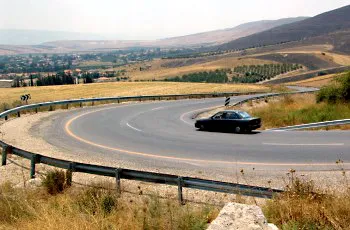 What are the characteristics of a mountain road?✓ Narrow and winding roadway, sharp curves, bends and sudden slopes.
- What risks are expected whilst driving on a mountain road?✓ Loss of braking ability and head-on collision. Difficulty yo pull off the road.
- How can we minimize the risk of brake loss while driving on a mountain road?✓ Drive in anappropriate (low) gear and avoid excessive use of the brakes.
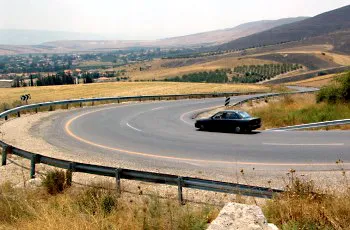 How can you avoid frontal collision while driving on a narrow and winding mountain road?✓ Drive on the far right of the roadway, turn-on the lights, and adjust your speed to the road’s conditions.
- What causes a vehicle to skid on the roadway?✓ When the braking forces or the vehicle's inertia exceed the tire’s ability to grip of the roadway.
- While braking and slowing down, what force of nature is applied on the vehicle?✓ The force of inertia, i.e. the force which causes the vehicle to continue moving.
- While turning, what natural force pushes the vehicle against the direction of the turn?✓ Centrifugal force.
- What are the elements that contribute to vehicle skidding?✓ Every element that prevents direct contact between the tire and the roadway, such as: water, oil, mud, gravel, etc.
- What are the reasons for a vehicle skidding on a road?✓ Late and sudden braking and the presence of elements that prevent traction on the road’s surface.
- What is the imminent danger when a vehicle skids whilst driving?✓ Loss of steering ability and loss of control over the vehicle.
- How can we moderate a situation in which our vehicle skids on the road?✓ Through correct speed ,steering and a correct and early use of the brakes.
- How can we prevent our vehicle from skidding?✓ By driving reasonably and using the brakes in a gentle manner.
- What specific problems do drivers face at night?✓ Restricted field of vision, being dazzled )blinded) incorrect distance estimations.
- What would you do when driving at night and you are dazzled )blinded) by a vehicle approaching from your opposite direction?✓ Slow down, keep to the right and look at the yellow line or at the right edge of the road.
- How can you manage to keep your braking distance within the range of your vehicle’s lights while driving at night?✓ By adjusting your driving speed to your field of vision at all times.
- How can you reduce the effect of being blinded by a vehicle approaching from your opposite direction?✓ By not looking into the blinding light, and by slowing down and driving on the right of the road.
- What are the risks of driving continuously for many hours?✓ Severe tiredness and a tendency to fall asleep.
- How can we overcome the problem of tiredness whilst driving?✓ By having adequate rest before driving and making rest and refreshment breaks during your journey.
- Can a short refreshment break whilst driving lessen the driver’s tiredness?✓ Yes, for a short time.
- From which side should a driver approach his vehicle before entering it?✓ From the vehicle’s front and he should face the traffic.
- What should be the initial actions taken by a driver after entering the vehicle and before starting to drive?✓ Adjusting the seat, steering wheel, mirrors and head rests.
- What are we required to see in the inner mirror of the vehicle?✓ The surrounding that is seen from the rear windshield and, as much as possible, from both its sides.
- What are we required to see in the outer side mirrors of the vehicle?✓ The tip of the vehicle’s side body and the road at the sides of the vehicle.
- What are we required to ensure before starting to drive?✓ That we can operate and use the vehicle proficiently.
- What are we required to check and verify before starting-up the vehicle’s engine?✓ That the foot brake is pressed, the parking brake secured, the gear handle is in Neutral (N) and the clutch is pressed (in automatic vehicles – Parking (P))
- How would you avoid danger when starting to drive?✓ By observing correctly the road and the traffic on it, before starting to drive.
- What is the correct way to check the road when starting to drive and merging with traffic?✓ Glance in the mirrors and turn our head in the direction to which we intend to drive.
- Is it enough to signal only when you begin to drive?✓ No, signaling doesn’t give you any right. You need to make sure that you look around correctly in addition to signaling.
- What are the provisions for driving in a straight line, without swerving?✓ Focusing on the furthest possible object you can see.
- What are the advantages of looking far ahead?✓ Obtaining all the information required for planning the drive according to the road’s conditions and avoiding surprises.
- Being familiar with the different systems in the driver’s compartment whilst driving:✓ Allows the driver to fully concentrate on the traffic and the road.
- Proper adjustment of the driver’s seat:✓ Allows you to comfortably see the road and to have an easy and non-tiring drive.
- What measure is it important to take before stepping on the brake pedal in order to slow down or to stop?✓ Check if there is a vehicle behind by glancing at the mirrors.
- How can a correct grip of the steering wheel help to control the vehicle and to keep it stable?✓ A correct grip of the steering wheel allows precise turning of the wheel, thus allowing control at all times.
- In a vehicle with a manual (regular) gearbox, it is important to adjust the gears:✓ In order to determine the driving speed.without strain on the engine.
- What is the correct order of actions while reducing the vehicle’s speed?✓ Slowing down and shifting to lower gear.
- What limitations does a driver experience while driving in reverse?✓ Limited field of vision and uncomfortable vehicle operation.
- At what speed are we required to drive in reverse?✓ Always slow.
- What are you always obliged to do while driving in reverse?✓ Take care as well as appropriate measures to prevent danger, impact, nuisance or disturbance.
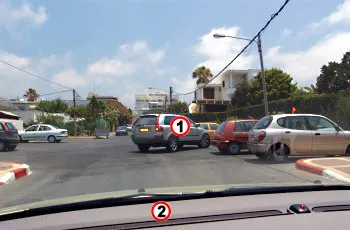 The silver vehicle (1) exits from parking while driving in reverse. What would be your reaction?✓ Slow down and prepare to stop (2).
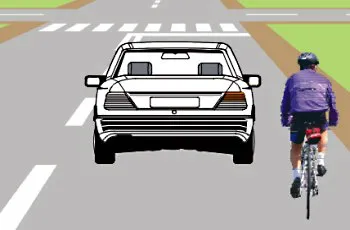 What should a driver do when he intends to turn right?✓ Take into account the chance that there will be a cyclist to his right during the turn, and take measures to avoid hitting him.
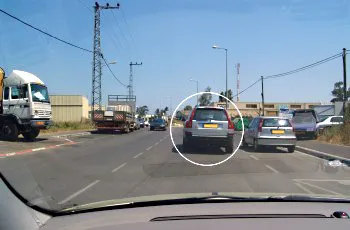 What should you do when your driving lane is blocked by the double-parked silver vehicle (marked with a circle)?✓ Slow down, allow the vehicle coming from the opposite direction to pass undisturbed, and then overtake the parked vehicle.
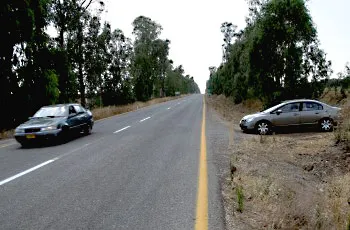 What is the required conduct of a driver that exits a dirt road and intends to enter a paved road?✓ He should give way to all vehicles on the paved road, from right and left, and then enter the road.
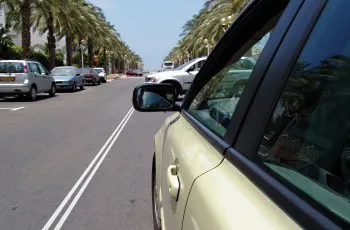 According to the following picture, is it permitted to deviate to the opposite lane?✓ No, due to the double continuous separation line on the roadway.
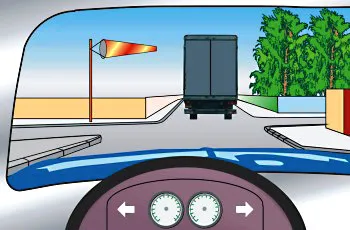 How would a strong side-wind affect the movement of the tall truck?✓ The wind pushes to divert the truck, and the truck driver would be forced to slow down and overcome the lateral force that pushes him to the side.
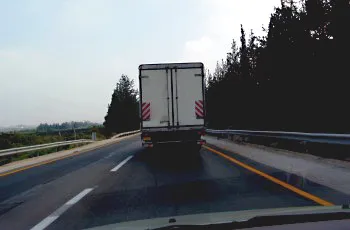 What effect does the distance between vehicles have on the overtaking process?✓ Short distance reduces the field of vision and increases the risk in overtaking.
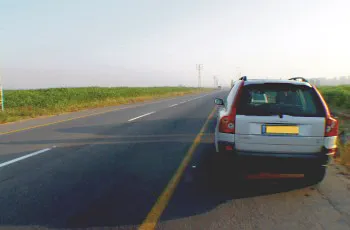 According to the following indications, how many vehicles are standing in front of you?✓ There are two vehicles in front of you. There is the silver vehicle and another shadow in front of it.
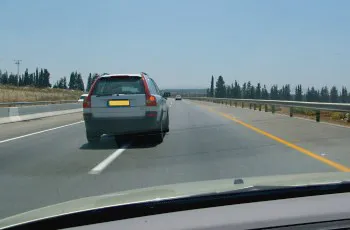 What are you required to do when you see that the overtaking silver vehicle intends to return to the right lane?✓ Allow it to return safely and without disturbance.